Story link: http://www.goodnewsindia.com/index.php/Magazine/story/jaipur-foot
"Oh, Jaipur foot!" you exclaim. "I know all about it."
Well, what do you know? That the artificial foot was invented in 1968 in Jaipur by a traditional craftsman? That the orthopaedic surgeon Dr P K Sethi, who brought it to the world's attention, got the Ramon Magsaysay Award in 1981?
Both true, but there's more to the story. Master craftsman Pandit Ram Chandra Sharma got no share of the prize money nor enough of the credit. Dr Sethi went away with the prize to consult for a commercial hospital fitting prosthesis. Between 1968 and 1975, only 50 or so limbs were fitted.
Yet, since 1975, over 300,000 limbs have been fitted. Another 600,000 beneficiaries have received calipers, crutches or tricycles. All given away free. India became the world leader in practical, low-cost foot prosthesis. And the Jaipur foot has become available throughout India and 18 other countries.
How did all this come about, if the invention crawled for 7 years after it won world acclaim? For that you have to meet the self-effacing Mehta brothers. That's the real story of Jaipur Foot's success.
Revived by a crash:
How Pandit Ram Chandra Sharma came to develop the Jaipur foot has been well told. He had been invited in the 1960s, by Dr Sethi to teach art as therapy to polio victims at the SMS Hospital. 'Masterji' as he is widely known, is however a restless man prone to looking around for problems to solve or things to make. He watched amputees being fitted with impractical, expensive, imported artificial limbs.
Ever the experimenter, Masterji created a foot made of vulcanised rubber hinged to a wooden limb; and the Jaipur foot was born. It has been continually innovated ever since with active involvement of Masterji. Its essence has however remained: ease and speed of fabrication, lightness in weight, low cost and suitability for working people in the Third World. Though the innovation attracted world-wide appreciation and gave Dr Sethi the Prize, it largely remained an object of adoration and failed to reach the thousands in need of it.
That process that took the foot to the people, was triggered by a crash. In 1969, a promising young IAS officer, Devendra Raj Mehta, was battered in a road accident in Jaisalmer, Rajasthan. It left him with over 40 fractures and many months in bed. It nearly wrecked an illustrious future that was to include Deputy Governorship of the Reserve Bank of India, Director Generalship of Foreign Trade and Chairmanship of Securities and Exchange Board of India [SEBI].
After his long stay in bed ended, he was advised physiotherapy at the Sawai Man Singh [SMS] Hospital in Jaipur. The Jaipur foot had recently been invented and he saw poor, maimed people throng the hospital in search of it. They lived on the streets and waited their turn for a fitment. Mehta during his several visits, was struck by the huge number that was in need of prosthesis.
Prompted by Mahavir:
He recalled that experience later. He was back in service and risen to be Principal Secretary to Chief Minister Hardeo Joshi. 1975 was the 2,500th birth year of Mahavira, the founder of Jainism, which the Indian government wanted all states to celebrate fittingly. Leaping over obvious token gestures, D R Mehta suggested rescuing the Jaipur foot from its neglect and delivering it to the needy.
"Where will we do it?" asked the Chief Minister. "We have no funds for building and stuff." Mehta suggested using ramshackle ambulance garages of SMS Hospital. His proposal was accepted. The Bhagwan Mahaveer Viklang Sahayata Samiti [BMVSS] was born in 1975. Masterji was delighted to be back in active mode.
Technology by itself cannot bring about change, however elegant it may be. The Jaipur foot was no doubt a technical winner but what made it lie unavailable to the needy? There were no processes to manage its delivery in thousands.
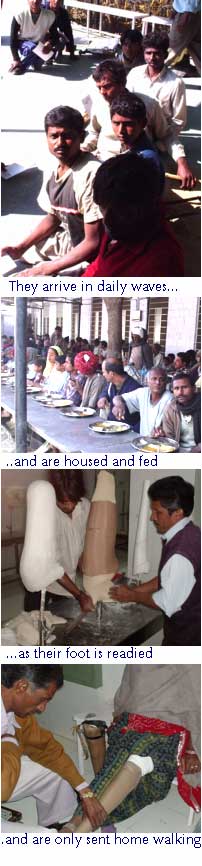
"The first thing I wanted changed was the approach to visitors," says Mehta. "It had to become human". It was common for the maimed to arrive at SMS Hospital and be made to wait for days for mere registration. "These are usually poorest of the poor who lose their limbs in the course of daily labours for employers who took no responsibility. They arrived penniless, starved and were without shelter as they waited for days in hope of being fitted with a limb," he says.
When BMVSS began operations, the first practice he put in place was that registration must be done on arrival, round the clock. Then the patient is given food and a bed. He and a caretaker are hosted till his limb is custom fitted. And she walks out upright in dignity, with return fare in hand. No fees of any kind is ever collected. The whole service is free.
Amputees waiting in wards quicken the craftsmen, many of whom wear the Jaipur foot themselves. There is an ordered assembly line approach to fabrication. Amputee's stump is covered with a knitted sock and a plaster of paris mould is made. From this socket a plug is made which is an exact replica of the limb. High Density Polyethylene Pipe [HDPE] is warmed and stretched over the plug. A vulcanised rubber foot is attached and suitable straps are provided to fasten the limb to the body. Most of the time, fitment is on the same day and comfort with using it is achieved in hours.
An Indian foot:
The Jaipur foot costs about Rs.1,300 to make.[The beneficiary of course pays nothing]. It can be made by an averagely skilled team of five, which can produce 15 limbs a day. But that is not the end of its merits. It's a limb that is suited for Indian use. Wearing it, one can work in the fields, run, pedal a bicycle, squat on the floor or even climb a tree. In contrast, a prosthesis from the West is mostly cosmetic.
True art seeks no prize:
Pandit Ram Chandra Sharma's family has lived in Jaipur ever since the city was conceived. His ancestor sculpted the idol at the Amber Palace temple. Masterji has studied only up to Class 4 but his blood probably carries all the lessons he needs. He is versatile on paper, canvas, stone, wood, glass and metal. Being curious, he investigates every modern material and manufacturing process.
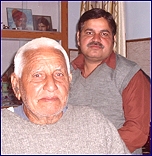
He is a fit 85 and rides a 50 cc moped every day to the Malaviya Nagar centre of BMVSS and potters around- experimenting, supervising, counseling and mentoring. In the evening, on the ride back, he stops at the vegetable market to shop for the family dinner. He is an uncomplicated man and evidently very content. Though many are agitated that he received neither credit nor a share of the Magsaysay Award money, Masterji himself has no grievance. In fact, he admits he could not have brought the innovation to the world's notice. "I am glad it happened and many have benefited," he says.
Recognition may have eluded him but the gift of art flows on in the family. His son Kishan Lal Sharma -who also works at BMVSS- has developed a knack for custom moulding cosmetic replacements for severed noses and ears. He uses an imported mouldable compound used by plastic surgeons. "You would be amazed how many people lose these in rural India." he says wryly. He tries to make an indistinguishable fit. He feels satisfied at the happy difference these small prosthesis make in people's lives.
Masterji is but one of India's perennial stream, insufficiently celebrated by the 'educated' classes. But for them, there would be no India story.
...
Plot No 20, Suman Vihar, Imliwala Phatak, Krishna Nagar, Jaipur 302005, Rajasthan
Phone Home: 0141-591214 Kishan Lal's mobile: 0-98280- 70311
Masterji's original creation was in wood and then aluminium. Later, while visiting a pipe factory in Hyderabad, he was struck by a narration of HDPE's virtues: light weight, low cost, mouldability and strength. He grabbed a few lengths and returned to Jaipur. In a few days he had re-invented the foot again. Today body coloured HDPE pipe is manufactured specially for BMVSS use.
To scale up delivery, BMVSS conceived fitment camps. These are held all over the country. Schedules are published at their site. Local chapters screen and line up people in need of prosthesis. Expert team leaves Jaipur complete with equipment and materials. There over several days, limbs are fitted practically at victims' door-steps.
By the way, BMVSS supplies more than the Jaipur foot. For a start, there are above-knee and below-knee prosthesis. For polio victims calipers are supplied. For those cases that cannot benefit from either of these, hand-driven tricycles and crutches are supplied. Of late, they have begun giving hearing aids, as well.
An Indian foot:
The Jaipur foot costs about Rs.1,300 to make.[The beneficiary of course pays nothing]. It can be made by an averagely skilled team of five, which can produce 15 limbs a day. But that is not the end of its merits. It's a limb that is suited for Indian use. Wearing it, one can work in the fields, run, pedal a bicycle, squat on the floor or even climb a tree. In contrast, a prosthesis from the West is mostly cosmetic.
True art seeks no prize:
Pandit Ram Chandra Sharma's family has lived in Jaipur ever since the city was conceived. His ancestor sculpted the idol at the Amber Palace temple. Masterji has studied only up to Class 4 but his blood probably carries all the lessons he needs. He is versatile on paper, canvas, stone, wood, glass and metal. Being curious, he investigates every modern material and manufacturing process.
He is a fit 85 and rides a 50 cc moped every day to the Malaviya Nagar centre of BMVSS and potters around- experimenting, supervising, counseling and mentoring. In the evening, on the ride back, he stops at the vegetable market to shop for the family dinner. He is an uncomplicated man and evidently very content. Though many are agitated that he received neither credit nor a share of the Magsaysay Award money, Masterji himself has no grievance. In fact, he admits he could not have brought the innovation to the world's notice. "I am glad it happened and many have benefited," he says.
Recognition may have eluded him but the gift of art flows on in the family. His son Kishan Lal Sharma -who also works at BMVSS- has developed a knack for custom moulding cosmetic replacements for severed noses and ears. He uses an imported mouldable compound used by plastic surgeons. "You would be amazed how many people lose these in rural India." he says wryly. He tries to make an indistinguishable fit. He feels satisfied at the happy difference these small prosthesis make in people's lives.
Masterji is but one of India's perennial stream, insufficiently celebrated by the 'educated' classes. But for them, there would be no India story.
...
Plot No 20, Suman Vihar, Imliwala Phatak, Krishna Nagar, Jaipur 302005, Rajasthan
Phone Home: 0141-591214 Kishan Lal's mobile: 0-98280- 70311
Masterji's original creation was in wood and then aluminium. Later, while visiting a pipe factory in Hyderabad, he was struck by a narration of HDPE's virtues: light weight, low cost, mouldability and strength. He grabbed a few lengths and returned to Jaipur. In a few days he had re-invented the foot again. Today body coloured HDPE pipe is manufactured specially for BMVSS use.
To scale up delivery, BMVSS conceived fitment camps. These are held all over the country. Schedules are published at their site. Local chapters screen and line up people in need of prosthesis. Expert team leaves Jaipur complete with equipment and materials. There over several days, limbs are fitted practically at victims' door-steps.
By the way, BMVSS supplies more than the Jaipur foot. For a start, there are above-knee and below-knee prosthesis. For polio victims calipers are supplied. For those cases that cannot benefit from either of these, hand-driven tricycles and crutches are supplied. Of late, they have begun giving hearing aids, as well.
Addiction in 15 minutes:
By 1981, D R Mehta IAS, had outgrown Rajasthan. Greater responsibilities beckoned him to Delhi. His doting elder brother Surendra Raj [SR] Mehta however found DR unenthusiastic about the new job. SR found out it was the attachment to BMVSS. "What will become of the project? Could you help me out?" he asked. S R Mehta was a busy man in his own right. A metallurgical engineer who graduated from the University of Wales in Cardiff, he held a senior position in industry. He had little time to spare. But his admiration for and devotion to DR overcame him. "I can go over for 15 minutes every day," he offered. "No more."
"Oh, good!" exclaimed DR clapping his hands. "That'll do. I can go in peace." To keep up his commitment SR vowed to eat his lunch only after he had visited BMVSS at SMS Hospital garages. But he was puzzled as to how 15 minutes a day would help. He found out soon enough.
"Little did I realise what an addiction it was," he says with a chuckle. "25 years on, I can't think of a day without getting a fix at the centre."
The mission runs deep in Mehta family veins. There is yet another brother, Virendra Raj [VR] Mehta. He too is a civil servant who had a decade long spell with the Asian Development Bank at Manila, Philippines. While there, he set up a prosthesis centre along the BMVSS model, using its technology.
That kind of dedicated volunteerism has made BMVSS a highly admired, respected organisation all over the world. Its annual budget is about Rs.7.00 crores, more than half of which comes from India's Ministry of Social Justice.
Faith in assured, continued support drives D R Mehta-now retired from service- to build a large centre for BMVSS at Jaipur's Malaviya Nagar. It is almost ready. It will centralise all activities, including research. Chief amongst that is evaluation of polyurethane in place of rubber, for the foot. They are also collaborating with North Western University, USA to eliminate use of plaster of paris. This is in the end, a big litter quite apart from being a recurring expense. In the new technique, they will work with reusable materials.
Here's a moment: Building workers are scurrying about in the new centre. Masterji and D R Mehta are sitting, fussing over little Yash of Dehra Dun, down from the hills for a refit. He was run over by a van as he played in his lane. He is just over five and as he is constantly growing, will require frequent replacements. D R Mehta, then looks up and says quietly, looking into the distance: "There is always money available for well conceived, well executed, transparently accounted social work. It needs some effort yes, but the money always comes through."
The foreign legion:
Clearly the work of BMVSS endears itself to everyone worldwide. It has spread to 18 countries. In several of them the people whom it helped were land-mine victims. As this story goes online, ten tonnes of materials have been packed ready for a camp in Pakistan. It will be a new frontier to be conquered by love. That will surely happen, going by the following report in a Pakistani paper, on the effect a Jaipur foot camp had in Afghanistan:
From Dawn, Jan 19, 2002
"As aid pours into Afghanistan, a special consignment from India is probably bringing more happiness to Kabul than the rest of the world's cargo combined. Low-tech, cheap and rubbery it may be, but it will transform the lives of Afghans who, after two decades of war, have had one or both legs blown off by land mines. The consignment consists of 1,000 pieces of the Jaipur foot, a prosthesis named after the city where it was developed in 1970. It was taken on a special Indian air force plane to Kabul earlier this month.
"As goodwill gestures go, it has probably earned India more appreciation than any amount of diplomacy. News that the Jaipur foot was coming to town, broadcast on radio and television, prompted desperate amputees on crutches to lay siege to the newly opened Indian embassy. "Thousands of Afghans applied for it. I was taken aback at the tremendous response," says SK Lambah, the special envoy sent to Afghanistan recently by India."
The Mehta brothers are unlikely to be surprised, though. Only quietly satisfied.
______________
Bhagwan Mahaveer Viklang Sahayata Samiti
D R Mehta, Founder and Chief Patron
S R Mehta, Secretary
SMS Hospital Campus,
Jaipur -302004, Rajasthan
Phones:[0091][141] 2563063; 5062227
email:bmvssjpr@datainfosys.net
Website: http://www.jaipurfoot.org
To express your intent to donate, click here
______________
April, 2006